
TheMagic5 Swimming Blog
I've spent more hours holding a kickboard than I'd like to admit. And for most of them, I was kicking in a position I never actually swim in.
Grab a standard foam board and the same thing happens to almost everyone. Your chest lifts, your head comes up, your hips sink and your shoulders take the load. You're working hard. You're just not training the kick you use when you swim.
That bothered me enough to do something about it.
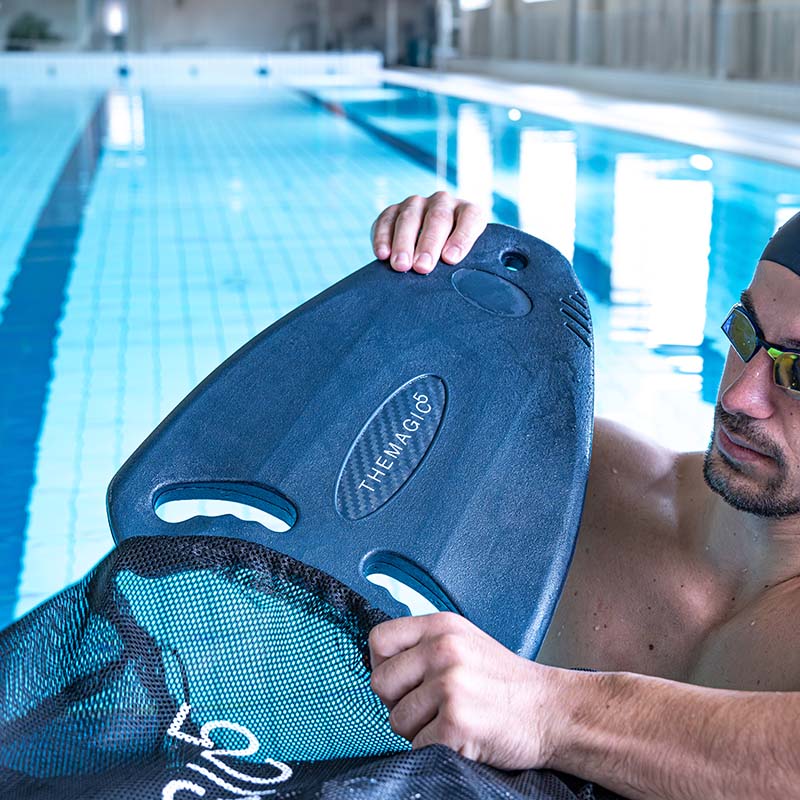
The goal was simple: a board that lets you kick in a neutral, streamlined position, not one that props you up like a deck chair.
It keeps you low. Instead of forcing your upper body high out of the water, the board lets you sit naturally, closer to where you'd be mid-stroke.
It's contoured. The shape supports alignment through the shoulders, torso and hips, so your body stays connected and can rotate the way it does when you swim.
It takes the pressure off your shoulders. Holding a flat board up and in front of you loads the shoulders fast. A lower, more natural position means the work stays in your legs, where it belongs.
It's still a kickboard. Lightweight, durable, built to live in your kit bag. It just puts you in the right place.

Kick sets are only useful if the kick carries over. Train your legs in a position you never swim in, and you're building a habit you'll have to unlearn.
When your body position is right on the board, the kick you build is the kick you race with. Same alignment, same hip drive, same rhythm.
That goes for everyone. Competitive swimmers chasing tenths. Masters swimmers who want sessions that don't wreck their shoulders. Triathletes who want a more efficient swim without burning their legs before the bike. Or anyone who's just tired of kick sets that feel like punishment.
Not all kickboards are created equal. This one is built around the position you actually swim in, so every kick set counts.
Next session, try a 200 kick on a regular board, then repeat it on ours. Notice where your hips sit. Notice your shoulders. That's the difference.
— NH

Please enter your Team Passcode below
From a quick smartphone scan, our internal AI analyzes your facial structure and determines the optimal fit, generating a custom design made only for you. Using specialized machine learning models, we transform your data into perfectly fitted swim goggles. Learn more here.
We offer standard and express shipping options.
USA (Shipped from New York)
Standard: 6-days
Express: 3-days
International (Shipped from New York)
Standard: 14-days*
Express: 3-5 days
*Applies to most countries, variations might apply locally. This will be shown at checkout.

