Tips, Tricks & Swim Exercises
Hayden Wilde’s Swim Faster Playbook
Apr 2, 2026
Tips, Tricks & Swim Exercises
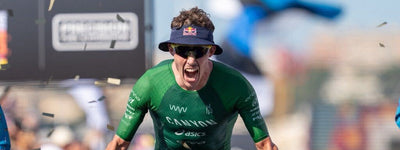
Hayden Wilde is one of the best triathletes in the world but swimming is where he has always needed to work the most. While the results—Olympic medals, WTCS podiums, and T100 dominance—are visible, the process behind them is far more methodical. At its core, Wilde’s progression in the water comes down to three things: consistent technique work, precise cues, and a willingness to rebuild when necessary.
His secret weapon in the last few years is Fred Vergnoux, the famous swim coach based in Antibes, France. Vergnoux, who has also worked with Canadian phenom Summer McIntosh, met Wilde in the run up towards his silver medal performance at the Paris Olympics. While we can’t all have the opportunity to work with Vergnoux, Wilde shares some of their techniques and tactics that keep him improving and at the top of the sport.
Despite training at the highest level, Wilde’s swim volume is not excessive. Instead, the emphasis is on quality and intentional time in the water–even when he is doing a focused swim training block or “swim camp.”
Being based in Andorra, Wilde works remotely with Vergnoux but periodically travels to France for focused swim camps. That makes it sound like double 10km swims every day for weeks but Wilde says it’s not like that.
“It’s nothing extreme,” he says. “Around 4.5-5K. It's not 10 k sessions because for [triathletes] it's just pointless. But it's just time in the water and having extra time to focus on the little things. If I'm doing a double day, it might be more technique based in the morning and then the afternoon will be more sprint speeds.”
This structure reflects a key principle: more meters don’t automatically equal more speed. Instead, when focusing on his swim development, Wilde prioritizes sessions that allow him to refine mechanics when fresh, then apply them under fatigue later in the day.
When Wilde is doing a swim camp, he isn’t afraid to sacrifice a little bike and run fitness. Actually, he says honestly, during swim camps, his bike and run “suck.”
“I’m just so fatigued. For me, I need to focus on my swimming a lot. There's a lot of other people that don't but when I'm in a full camp with Fred for a few months, I try to swim nine times a week. It'll be two double swim days a week, like Wednesday and Friday, and you're just more fatigued all the time because you're tired from being in the pool.”.
For Wilde, improvement in the water is never about overhauling everything at once. It’s a gradual, highly controlled process.
“ I'm always trying to fine-tune my stroke but I feel like it has to be done gradually and not just all at once. If you do it all together, you just swim like a set of keys and it doesn't really work. If you just focus on one little thing for a month and then focus on another little thing for another month, you'll slowly get to a technique where it feels pretty good.”
This incremental approach is one of the most transferable lessons for any swimmer. Instead of chasing wholesale changes, isolate a single technical focus and build it until it becomes automatic.

Cycling and running have their technical aspects but swimming is a whole different beast. You can only muscle your way to being faster in the water for a very short amount of time until technique holds you back. With a laugh from personal experience, Wilde says nothing makes this clearer than being beaten by kids in the pool
“You're going to have a reality check when a 10-year-old boy or girl is faster than you in the water. They aren’t going to be stronger than you in an arm wrestle or bench press or anything but their technique is so good and it’s so connected to the water that they’re just grabbing it so much better than you. It’s not just all about power or how strong you are, it’s how you connect with the water.”
“Technique is so much more important. It sucks because it doesn't feel like you're not doing anything or you do something really easy and it feels like you're doing nothing. But in swimming, you just have to dedicate one day to an easy swim that is purely a specific to technique–and I feel like that goes a long way.”
Wilde’s philosophy on swimming is clear: technique is the primary limiter—and the primary opportunity.
One of the most practical elements of Wilde’s swimming is how he uses cues to shape his stroke. These are not abstract ideas—they are simple, repeatable thoughts that create tangible changes in the water.
“Everyone has their different cues,” Wilde explains. “One day something clicks when a coach explains it a different way–even when they're explaining the exact same thing they have before. You get to the same point, but it's just differently explained.”
His current cues are specific to avoiding crossover in the stroke and maintaining connection between the upper body and core.
Every swimmer will have different cues that work for them at different times in their swim development but Wilde stresses that having cues is essential.
While technique is the foundation, Wilde still backs it up with demanding sets that force him to execute under pressure.
“Two sets of 8 broken 200s,” he says referencing one of the hardest sets he does.
“You do it as 50 m max on 60 seconds go time and then into 150 on a 2 minute cycle. For me, I try to get out at 29-32 pace and then going into threshold, aiming for 1:42-3. You do that eight times and then 400 meters of recovery and get back into it.”
It’s a session that blends top-end speed with sustained threshold work, requiring both technical precision and physical resilience.
The key takeaway isn’t just the set itself, but how it’s used: once technique is established, sessions like this reinforce it under fatigue and build fitness.
“Having goggles that fit right, I think it's pretty important and it's a pretty essential part of your kit,” he says.
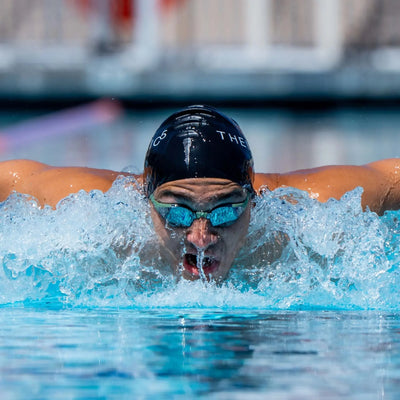
Wilde naturally came to use THEMAGIC5 when he was looking for a pain-free option that didn’t leak.
“ I was getting leakage here and there but also getting sore eyes from the pressure of tightening goggles,” he says.
“I saw that a lot of people were using THEMAGIC5 and saw how their technology worked with the face scan and I just wanted to give it a crack. From there, I started using the goggles in training and racing and I haven’t really taken them off since,” he says. “Every goggle that I've got from THEMAGIC5 fit perfectly.”
Wilde’s swimming didn’t transform overnight. It was built through years of small adjustments, reinforced by the right coaching, and supported by a willingness to step back and even fail in order to move forward.
The lesson is straightforward: faster swimming doesn’t come from doing more—it comes from doing it better.
And that starts with the details.
Please enter your Team Passcode below
From a quick smartphone scan, our internal AI analyzes your facial structure and determines the optimal fit, generating a custom design made only for you. Using specialized machine learning models, we transform your data into perfectly fitted swim goggles. Learn more here.
We offer standard and express shipping options.
USA (Shipped from New York)
Standard: 6-days
Express: 3-days
International (Shipped from New York)
Standard: 14-days*
Express: 3-5 days
*Applies to most countries, variations might apply locally. This will be shown at checkout.