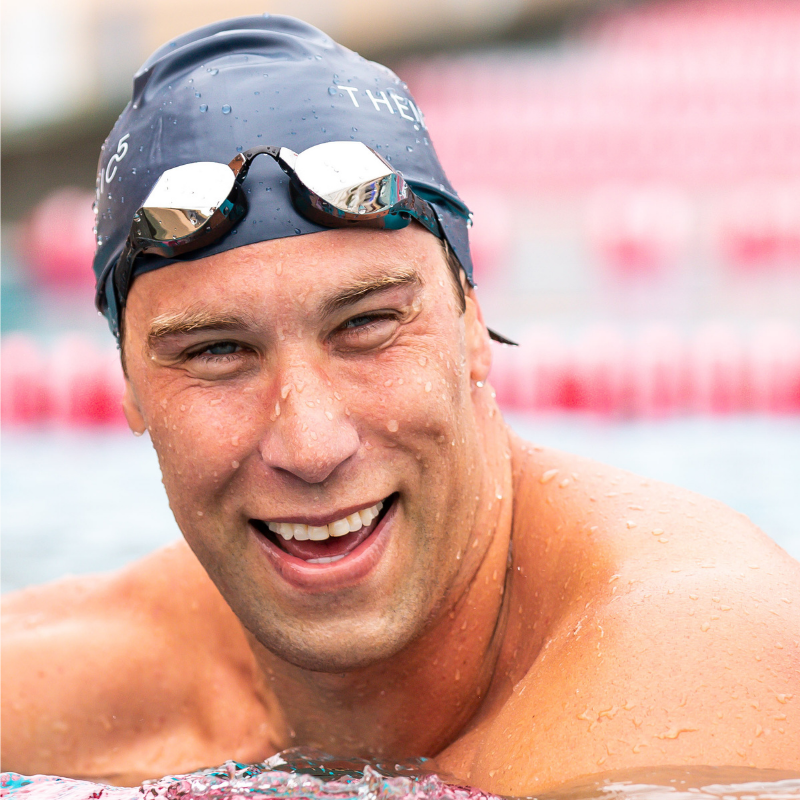
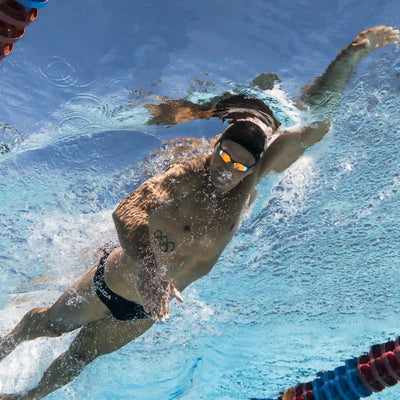
Sitting down with Matt Grevers for a video call, he’s happy and ready to go even though it’s 8am, an hour earlier than we planned to meet. Thanks to the recent clock change, he graciously agreed to meet early at the last minute. He’s smiling and relaxed and I can tell that’s his natural state. For someone who has accomplished what he has—two-time Olympian with four gold medals and one silver; multiple world champion in backstroke, freestyle, and team relays; and countless international medals (actually, it’s 28)—he is remarkably down-to-earth, easy to talk to, and settling into fatherhood. Well, he still hasn’t got that one completely figured out, he tells me.
Matt attended his last US Olympic Trials in June 2021. He fell short and didn’t make the Tokyo team in the 100m backstroke, his signature event; but, he left the pool to a standing ovation. Initially, Matt didn’t realize the roar of the crowd was for him. “To get a standing ovation even though I got sixth was amazing. It shows people appreciate not just me the swimmer and my performance, but me as a person and that means more to me than any performance I have had,” he said in an interview. That moment says more about Matt than his medals and it explains so much of who he was a swimmer and who he is now.
Businessman, partner, and father of two young daughters, Matt’s transition from professional swimming was something he had prepared for long before the day arrived. His first failure to qualify for the Olympic team back in 2016 urged him to restructure his life so it wasn’t entirely focused on swimming. While some saw it as a dilution and threat to his swimming performance, Matt saw it as a way to bring more joy and purpose into his life—and he went on to swim some of his fastest-ever times.
At the time, however, Matt struggled with how suddenly his whole life had changed because everything revolved around swimming.“Not making the Olympic team back then,” he pauses, “I was torn up for a long time. I was the defending Olympic gold medalist. I was medalling every year at international meets. Everyone thought I would make it. It wasn’t ‘if’ but ‘when.’ That was my identity,” he explains. Matt says his loss was reinforced everywhere he went. In public or at speaking events, people would ask him how he performed at the Olympics and he would have to explain why he didn’t even participate. At the most vulnerable moment of his career, Matt considered leaving the sport.
“But leaving the sport didn’t feel right,” Matt says, and I can see him reliving the turmoil. That’s the thing about Matt, you can see the emotion on his face. Not that he is an open book, but he’s honest and that’s something he credits to his upbringing.
His parents, who both immigrated from the Netherlands, raised him on the values of hard work, self-belief, and kindness, with a big side helping of Catholic guilt. “I couldn’t lie. If I secretly ate a cookie, it would eat me up inside,” he laughs. He explains how he had to earn his allowance doing chores— chores he would repeat until his parents were satisfied they were done correctly to the best of his abilities—a “Mr Miyagi situation.” Still to this day, Matt says he is a rule follower.“I’m intrigued by rule breakers but I can’t do it.”