Tips, Tricks & Swim Exercises
Conversation with David Shackley, CMO, THEMAGIC5 and Ivan Puskovitch, 2024 Paris Olympian (10K)
Written byDavid Shackley
Tips, Tricks & Swim Exercises
Ice swimming is not a metaphor. It’s not a training method. It’s not a cold plunge.
It’s a sanctioned, timed, governed sport under the International Ice Swimming Association (IISA), where athletes swim distances up to a full mile in water 5°C (41°F) or colder — wearing only a standard textile suit, one cap, and goggles.
No wetsuits. No neoprene. No margin for error.
Recently, Ivan took on his first official Ice Mile. I caught up with him to talk about preparation, shock, strategy — and what happens when your body meets freezing water.

David: How much time did you have to prepare specifically for this Ice Mile?
Ivan: The funny thing is the ice mile only entered my calendar about a week before I did it. Olympic legend Markus Rogan invited me to some ice swimming and mentioned that all the officials necessary to ratify an official Ice Mile would be there. He asked if I was up to give it a go — of course I said yes.
Ice swimming is something I’ve been learning more about since the Paris Olympics, and I knew I wanted to try it. I love a new challenge.
My training didn’t change. My coach and I already focus heavily on mile speed layered on top of 10K endurance, so physically I was prepared. We just didn’t have the luxury of a long lead-in.
David: Walk us through stepping into 40-degree water. What does it actually feel like?
Ivan: The hardest part was the first 90 seconds.
You don’t just dive in — there’s a specific IISA protocol. You remove your clothes, enter the water carefully, and then swim to the starting spot.
The initial entry came with involuntary hyperventilation. Thankfully I knew that was unavoidable, so I didn’t panic. Once the race started, the first 100 meters were about regaining breathing rhythm.
After that, something shifted. I entered a flow state.
Yes, I was cold — but it stopped getting colder. As I increased intensity, I could actually feel my body warming up. The only fleeting “What am I doing?” moment came in that first 100 meters. But I never doubted I could power through it.
David: For people unfamiliar with IISA rules — this is old-school swimming, right?
Ivan: Exactly. Standard textile suit, one cap, goggles, and optional ear plugs. No wetsuit.
To me, the Ice Mile is an ultimate test of grit in the face of nature’s harshest elements. A wetsuit would take away the challenge.
So much of what motivates me in my professional swimming career is the desire to meet and overcome challenges. This was no different.
David: The mile hurts in a pool. How does it compare in ice water?
Ivan: I didn’t go in with a complicated strategy. The plan was simple: start fast, stay fast, finish fast.
I needed to get my engine running immediately to generate heat, because my core temperature was inevitably going to drop over 20 minutes.
Early on, the challenge was regulating my breathing. By the end, it was not being able to feel my body at all.
Ironically, that’s good practice. At the end of a 10K you often can’t feel your stroke either — you just have to trust it.
David: What surprised you most?
Ivan: How good you feel after.
I had zero prior ice swimming experience. I’m not even the type of guy to take ice baths. But after finishing and making it to the fireplace — shivering, frozen — my brain felt incredible.
I completely understand how people get drawn to this.

David: Would you represent Team USA at the IISA World Championships?
Ivan: Absolutely.
The World Championships in Romania next year are something I’m keeping in the back of my mind as I build toward LA28. I’m confident I can get even better at it and represent Team USA well if given the opportunity.
I also want to meet more people in the ice swimming community.
David: In a sport where so much can go wrong — breathing shock, numb hands, pacing mistakes — how important is eliminating something like goggle leakage? You understand I need to ask you something about the goggles, right?
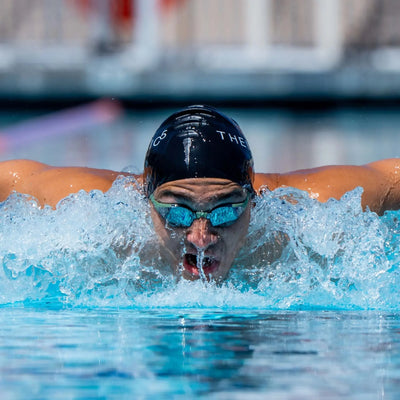
Ivan: I was waiting! TheMagic5 goggles were definitely an asset during my Ice Mile.
It’s already hard enough swimming in ice water — I can’t imagine doing it with leaky goggles.
By the end of my swim, my face actually burned the most from the cold because I hadn’t been moving it. Experiencing that along with ice water getting into my eyes would have been unbearable.
Thankfully, I didn’t have to worry about that.
Ice swimming strips the sport back to its essence. No insulation. No margin for error. Just the athlete, the water, and the will to keep moving forward. Watching Ivan embrace that challenge — and trust his preparation in an environment this unforgiving — is a reminder that in extreme conditions, simplicity matters. When the environment tests you, confidence in your equipment becomes one less thing to think about.
Please enter your Team Passcode below
From a quick smartphone scan, our internal AI analyzes your facial structure and determines the optimal fit, generating a custom design made only for you. Using specialized machine learning models, we transform your data into perfectly fitted swim goggles. Learn more here.
We offer standard and express shipping options.
USA (Shipped from New York)
Standard: 6-days
Express: 3-days
International (Shipped from New York)
Standard: 14-days*
Express: 3-5 days
*Applies to most countries, variations might apply locally. This will be shown at checkout.