Casper Stornes won the IRONMAN World Championship in Nice by getting the small things out of the way long before the start.
By the time Casper Stornes reached the start line in Nice on September 14, 2025, everything he could control was already done. The training was banked, the fitness built, the plan rehearsed until it no longer needed thinking about.
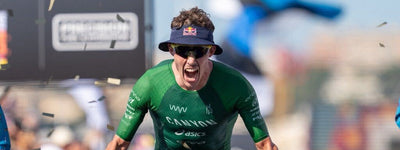
7 hours, 51 minutes and 39 seconds later, he was IRONMAN World Champion, leading a Norwegian podium sweep with Gustav Iden and Kristian Blummenfelt. More than 2,500 men raced that day. The three on the podium all spoke the same language.
At that level, races are rarely decided by one big thing. It's the small ones: nutrition, pacing, transitions, equipment. And before any of it matters,
Two point four miles of attention
Triathletes will happily spend an evening debating crank lengths or carbohydrate ratios. Goggles rarely get the same treatment. They're small, cheap by triathlon standards, and easy to replace, which is exactly why they're easy to overlook.
But an IRONMAN swim is 2.4 miles long, and goggles are one of the few pieces of kit you depend on from the first stroke to the last. A slow leak that's a mild annoyance in a pool session becomes something else entirely an hour into open water. So does pressure around the eyes, fogging, or losing sight of the next buoy in a crowded field.
For Stornes, the ideal piece of equipment is one that disappears.
"You can just feel when you put the goggles on that they are different to other goggles — they fit to your face," he says. "I just put on THEMAGIC5, jump in and don't think about them."
It sounds like a modest ambition. In long-distance racing, it's the whole point. Once the swim starts, attention belongs to rhythm, position and efficiency. Anything competing for it is a cost.
Ben Kanute puts it more bluntly. "The last thing you want in a swim is a goggle malfunction, uncomfortable goggles, or an impaired view," he says. "THEMAGIC5 goggles solve all of these issues and allow me to focus on the task at hand."
Why fit is so personal
The reason one pair of goggles works flawlessly for one swimmer and leaks relentlessly for another comes down to faces. Nose width, eye socket depth, brow line, cheekbones: they vary far more than a standard goggle shape can account for.
THEMAGIC5 starts from the other end. A smartphone scan maps each swimmer's facial geometry, and that data shapes a custom-fit frame. For Stornes, the practical result is simple: goggles on, straight into the water, no fiddling with straps or wondering whether the seal will hold.
The lesson carries well beyond custom kit. Don't find out on race morning whether your goggles work. Wear them on long sessions and pay attention to how they feel at 30, 45 and 60 minutes, not just the first few lengths. Comfort that fades is not comfort.

Open water asks more
Pools are forgiving. There's a black line below you, lane ropes on either side and a wall at the end. Open water removes all of it and adds glare, chop, shifting light and other swimmers, with buoys that seem to shrink the moment your eyes are at water level.
Seeing clearly makes sighting easier, and every clean sighting is one less interruption to your stroke.
"I see more with THEMAGIC5 goggles than with normal goggles," Stornes says.
For anyone building toward an IRONMAN, that's worth testing properly. Take your race goggles into open water. Practise sighting in them. Swim in different conditions, and make sure the lens you've chosen suits the light you'll actually race in, not the light you'd like to race in.
Trust, built in advance
Hayden Wilde describes the same idea in terms of focus. At the sharp end of triathlon, attention is already split between pacing, tactics and everything happening around you. There's no spare capacity for kit.
"You shouldn't be thinking about your goggles when you're racing," Wilde says. "Even small distractions can break focus. With these, you put them on and you trust them. There's no adjusting on the pontoon. It's just focus and go."
Trust is the word elite athletes keep returning to, and it's never granted on race day. It's earned in training: swimming in the exact pair you'll race in, checking them for wear before race week, and carrying a backup you've already tested. None of that will make you fitter. All of it removes a variable from a day that has plenty.
What you can control
Stornes couldn't control the conditions in Nice. He couldn't control what Iden or Blummenfelt would do behind him, or every moment of a race that lasted nearly eight hours. What he could control was how prepared he was when the cannon went.
He didn't become world champion because of his goggles. But the way he talks about them says something about how champions think about equipment in general: test it, train with it, trust it, and then forget it exists.
Because once the race starts, there are more important things to think about.
Featured product